|
|
|
|
|
|
|
second clause (crossing the street) by embedding it in the main clause (seeing the girls). As Leech remarks, the truest "copy of the structure of events and circumstances we recognize in the reality around us" (288) is in fact the synchronous picture, or what he calls the orderless network of deep semantics. Sentence order "distorts" the "true'' picture by separating events in time and ranking them. Events do of course occur which "in reality" are indeed sequentially ordered and may be ranked in utterances by entailment and presupposition. But even here, sentences used to describe them can never fully overcome syntactic and phonological restraints, and approach the semantic accuracy of personally rather than grammatically ordered words. Like the painter and the poet, the schizophrenic speaker can say things with a shocking but brilliant poignancy that conventional sentences rarely attain. As with the initial jumbled speech of diviners, they operate more freely at a level closer to the orderless networks of deep-structure semantics. |
|
|
|
|
|
|
|
|
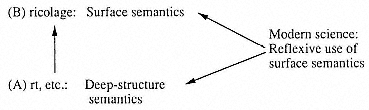
The shift from deep-structure to surface (sentence) semantics analytically parallels the shift in the diviner's speech style and narrative theme. We can recast what others call deep-structure semantics as the area of the most creative, artistic, poetic, and schizophrenic throught, and surface semantics as that of classification and taxonomy, i.e., of bricolage. To complete the model, modern science may be regarded as reflexive surface semantics, i.e., language used to refer to itself, including its deep-structure (which is what I have attempted in this essay). |
|
|
|
|
|
|
|
|
 |
|
|
|
|
|
|
|
|
The place of the two archetypes with which I began this essay can now be seen. Categorical overlap, crossing, or confusion (orderless networks) make up the area of deep-structure semantics and art. We are accustomed to the idea of this archetype being an object of the ritual attitude. More properly, we should say that it poses the intellectual puzzles which people seek to solve through aesthetically pleasing methods. The second archetype takes off from here and, in depicting the return from random wandering in the wilderness to straight and narrow paths, represents the movement from deep-structure to surface semantics (A)(B), or, in the particular case of divination, from jumbled to clear speech. |
|
|
|
|
|
|
|
|
We see, then, why the basic styles and themes of divination, at least in the society I have studied, are the same, regardless of the social circumstances of diviners. For they are part of a wider logic by which we solve problems as puzzles: by untangling them, and so clarifying and recognizing them. For that logic to operate we have to posit a simultaneity of confusion in the first place. This is the point at which I can bring the analysis to bear on the question in social anthropology of the innovative individual. |
|
|
|
|
|