|
|
|
|
|
|
|
since the 1920s, and consequently divination as a whole has become a male-dominated specialty. Three of the thirty-eight diviners, including one woman, practiced forms of divination other than spirit possession and book examination. |
|
|
|
|
|
|
|
|
Spirit diviners were thought to be chosen by spirit agents to take up divination. They may well have been familiar with the work through a close relative, but people did not think of becoming a spirit diviner in terms of apprenticeship. Rather some form of affliction, such as impotence, illness, and strange behavior, was attributed to spirits who wished to "settle" (ohwihala) and to work with the person they had chosen. Not everyone who received such an interpretation of misfortune became a diviner; it was possible to "say goodbye to" (ohusebula) divining spirits with a sacrifice, thus refusing the call. But those who accepted the call established a permanent relationship to their spirits. |
|
|
|
|
|
|
|
|
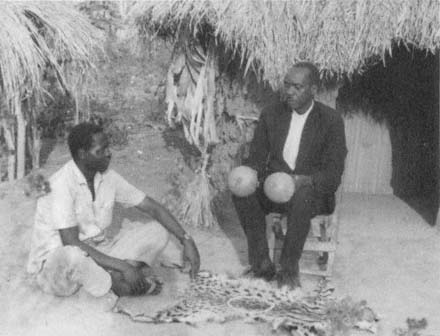
A house called amasawo, the divining hut, was built in the compound for these spirits, and they were thought to stay there. Some diviners seemed to conceive |
|
|
|
|
|
|
|
|
Heneriko Were, a Nyole diviner, in front of his divining hut with Emmanuel Mudoto,
one of the author's field assistants, 1971. The diviner is holding his gourd rattles; the
skin upon which he sits when divining is at his feet. Between the two men, near the
hut, is a bundle of grass associated with the divining spirit.
Photo by Susan Reynolds Whyte. |
|
|
|
|
|